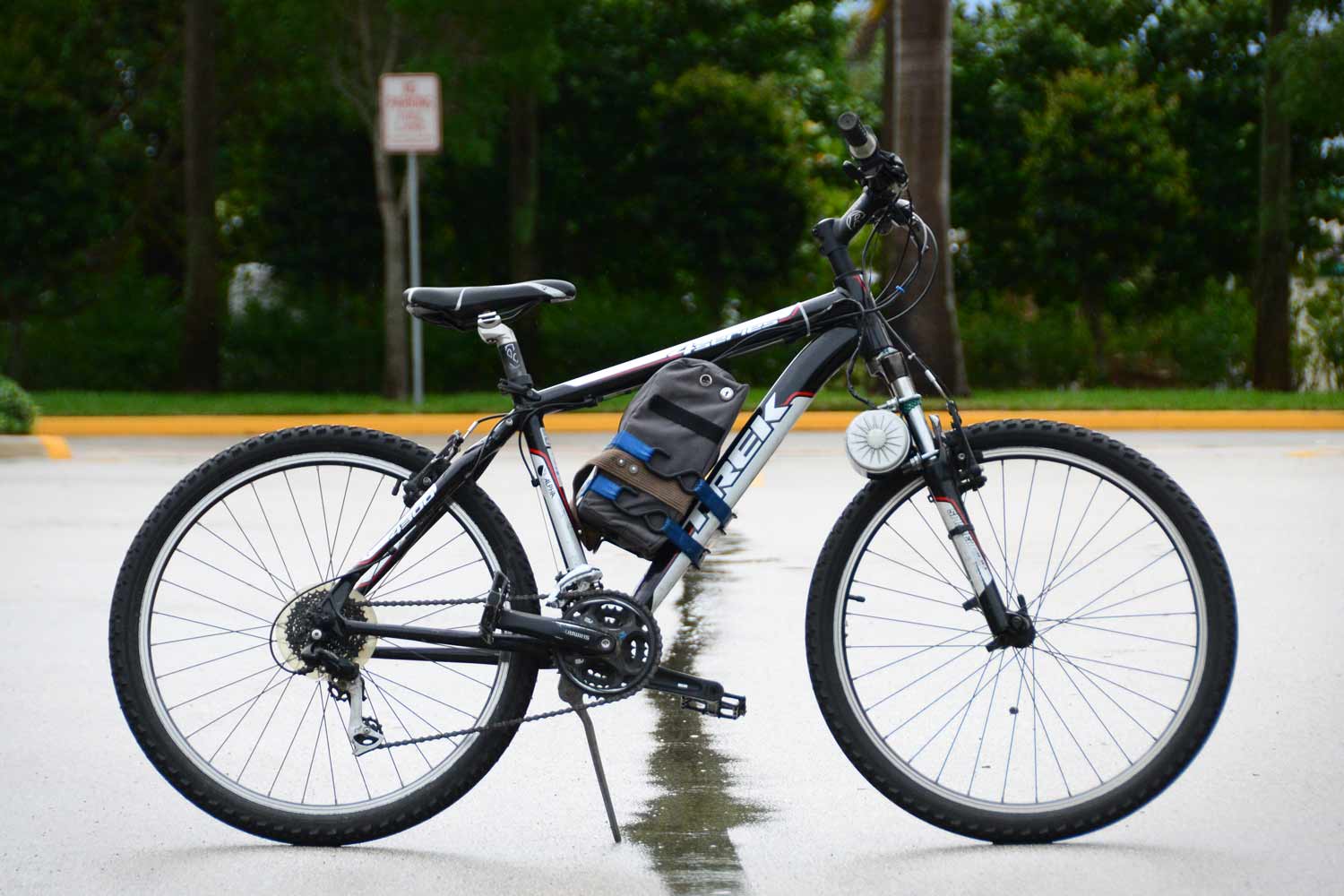
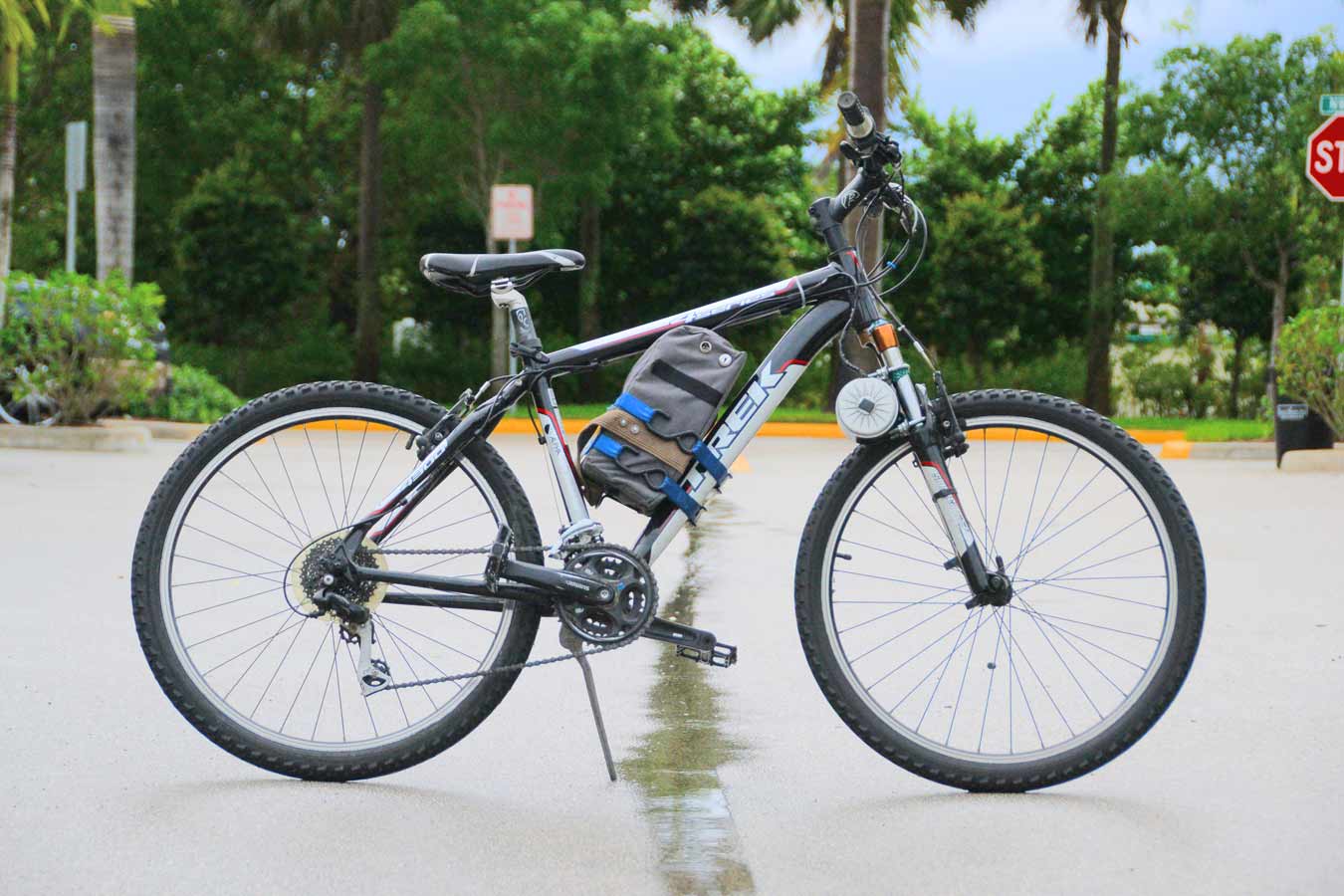
11 June 2014[This page was recovered from the TheStuffWeBuild WordPress Archive and adapted for this site in 2025.]To this day I have not found a better diy electric bicycle conversion with all the benefits of this one. It doesn't damage or alter the bike itself in any way, it's easily removed or transferred to other bikes, and it costs virtually nothing compared to the commercial kits and hub motors.
On a full charge, with two 12v 10Ah SLA batteries (a bit larger then the scooter's original 7Ah set), this motorized bike will pull you along at a brisk 20mph (32.2Kph) for 10 miles (16.1Km) seldom-assisted (I.e. only helping it when accelerating from stops). It certainly adds loads of fun to an otherwise normal bike ride. (Speed and range are dependent on drive wheel and bicycle wheel dimensions among other variables.)
The story of how the electric bicycle was born
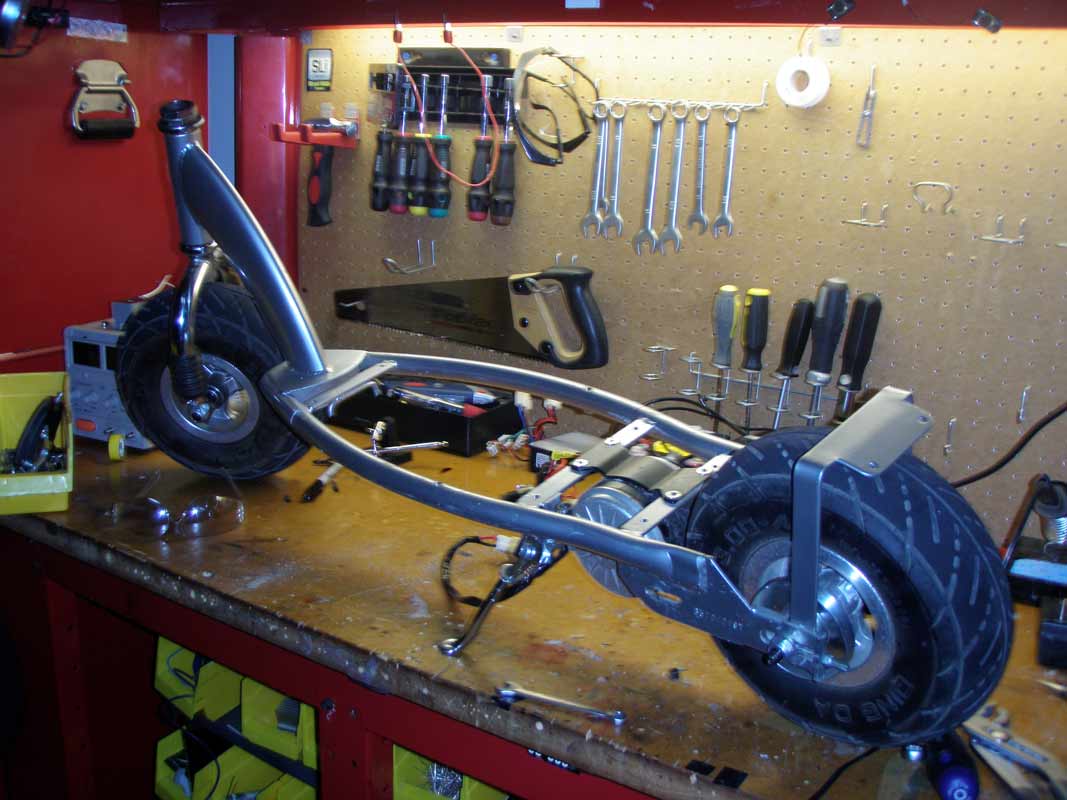
Circa 2008. At age 13 my adolescent mind desired a motorized bicycle. With absolutely no budget, I began brainstorming ways to cannibalize my seldom-used Razor E300 electric scooter with its rusty bearings and dry SLA batteries… This is the short story about how my DIY e-bike came to be.
A very early progress photo indicating the start of the project in '08. (Gutted Razor E300 - Green)
After some trial and error with some early ideas, and just as I was about to push the project aside for the upcoming school year, I came up with an Idea that uses two very simple U-bolts and structurally nothing else.
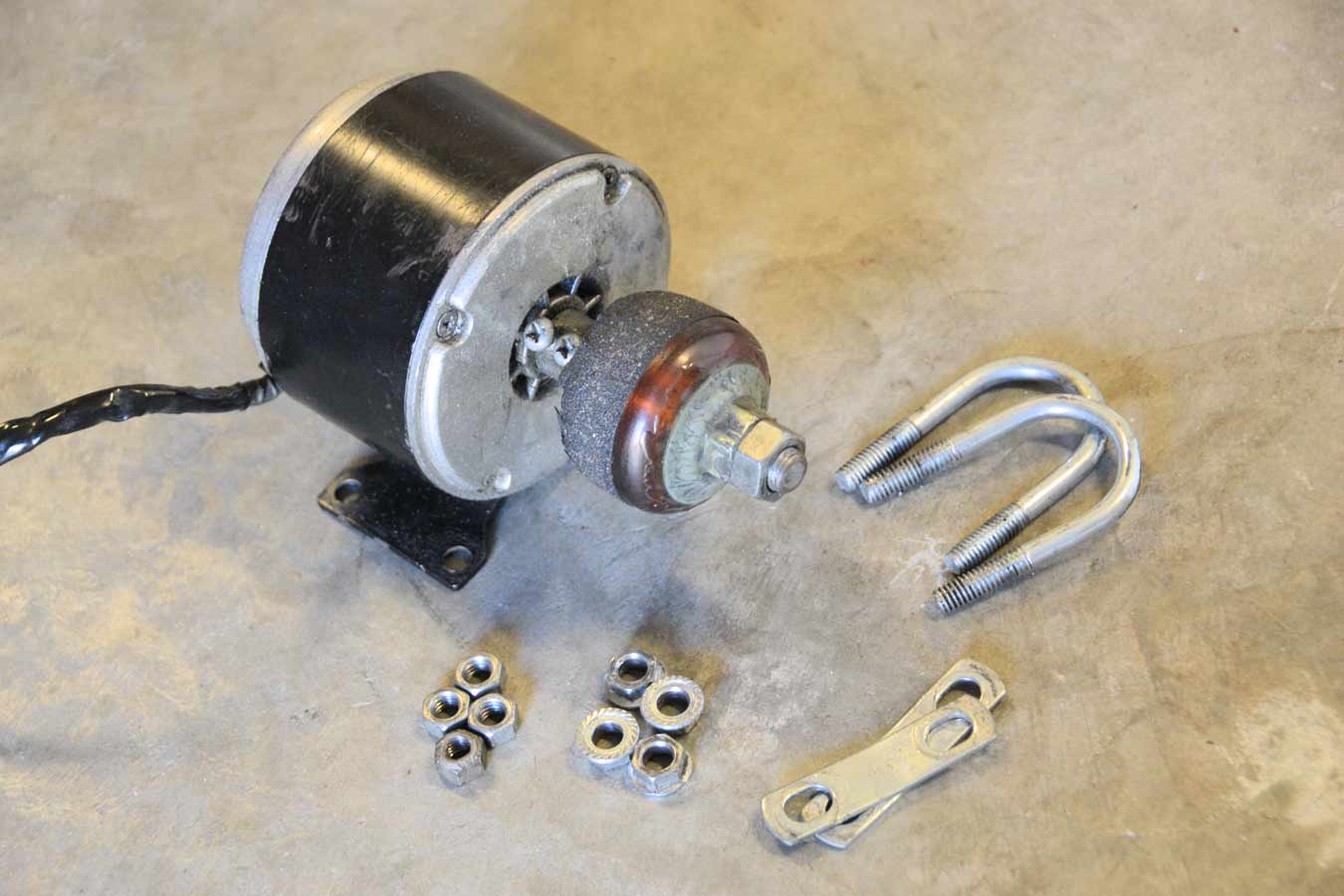
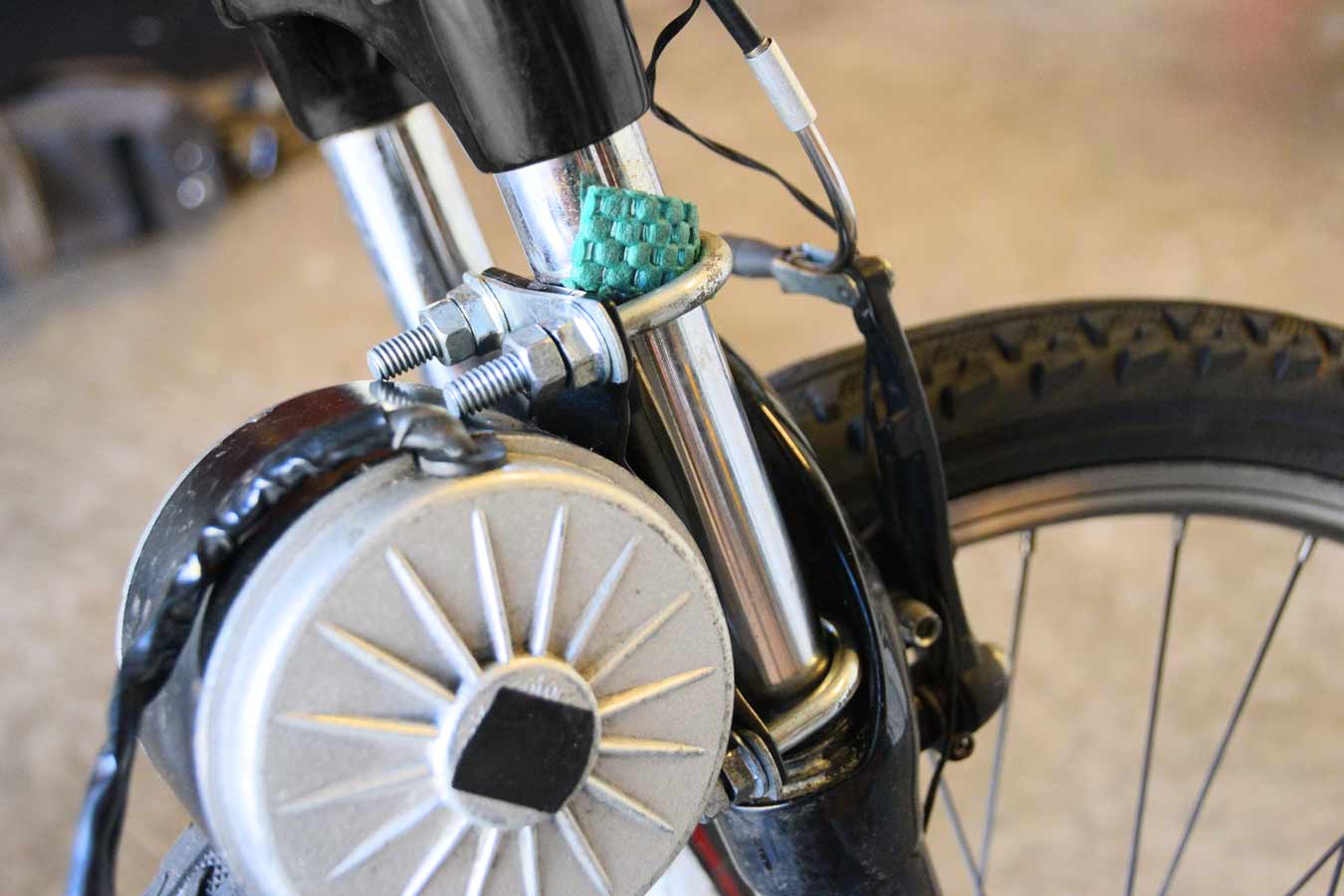
Budding the mounting flange of the 24vdc motor to the front fork of my Trek 4300 (and later the 4-Series) I took some measurements and persuaded my father to buy me two 1.5 inch U-bolts for a few dollars from the local hardware store.
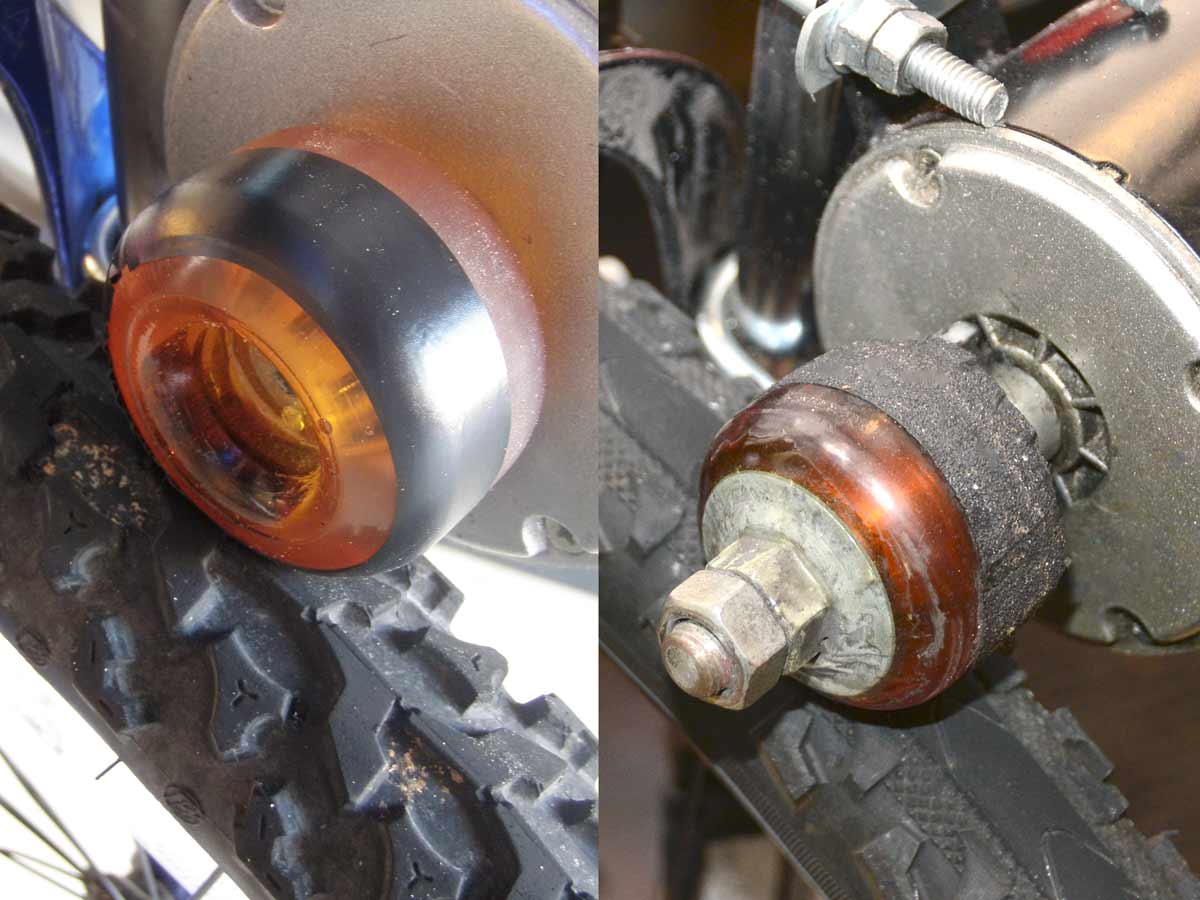
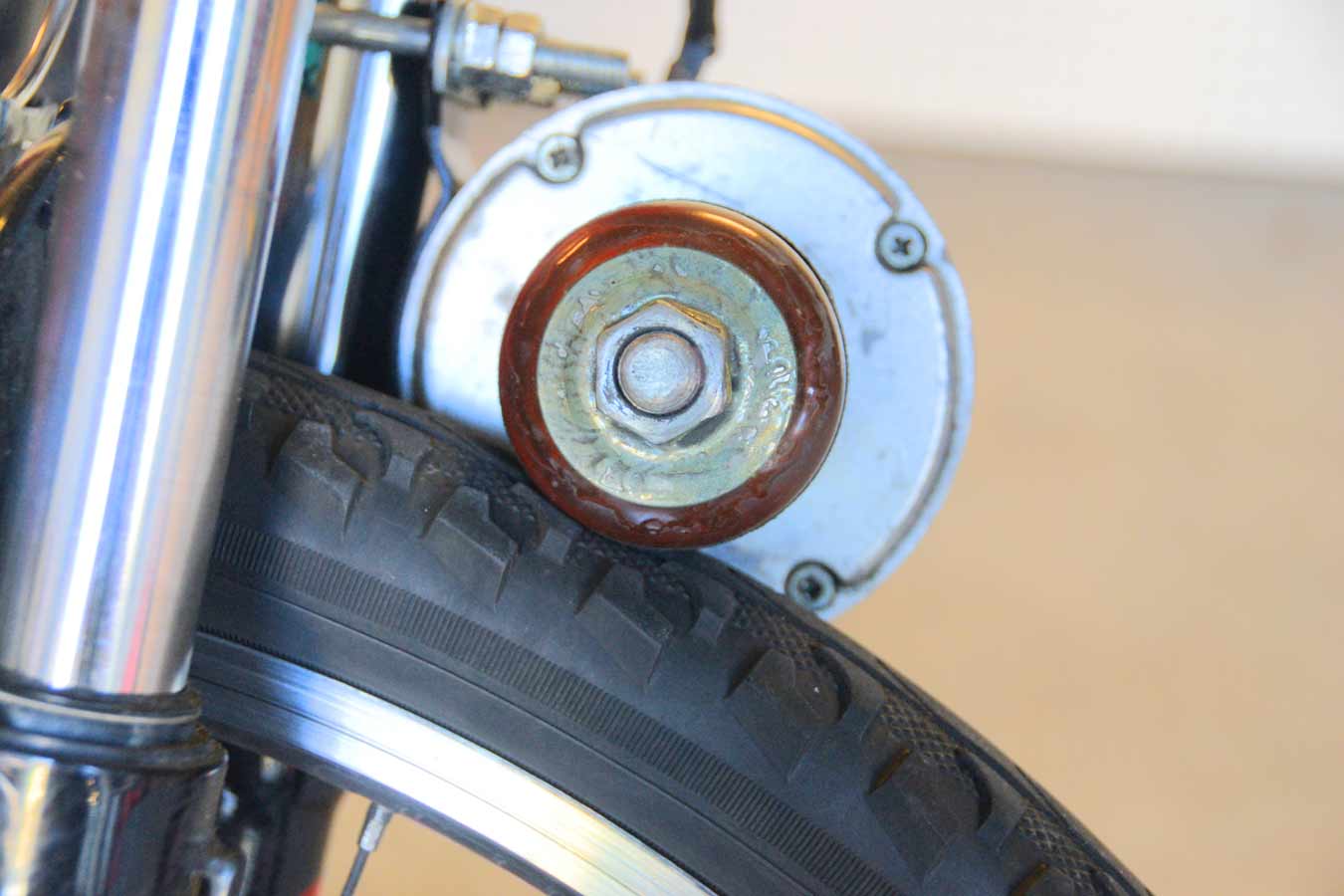
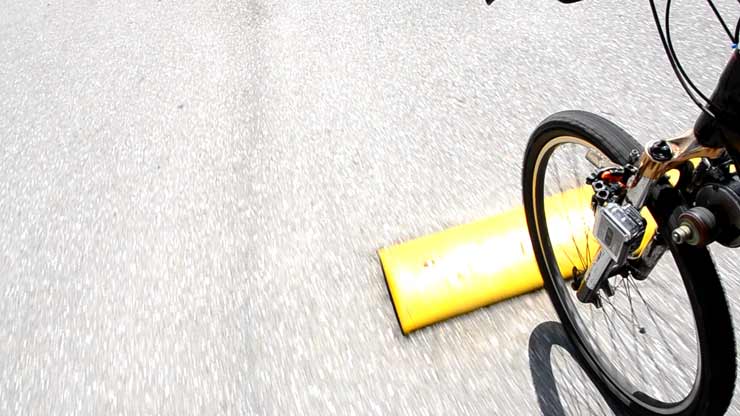
Some minor filing was needed on one of the bolts to get it to fit where I wanted it, but once I got the motor mounted to the front fork of the bike, and had the suspension locked (properly with dedicated switch), I had to find a way to deliver its output to the front wheel. For this, I found that a basic skateboard wheel (sans bearings) epoxied to the motor's original sprocket and nut would work just fine. I later replaced this with a proper motor arbor after I found the epoxy beginning to wear out. I also found that some all-weather grip-tape applied to this drive wheel gave it much more needed traction in wet weather.
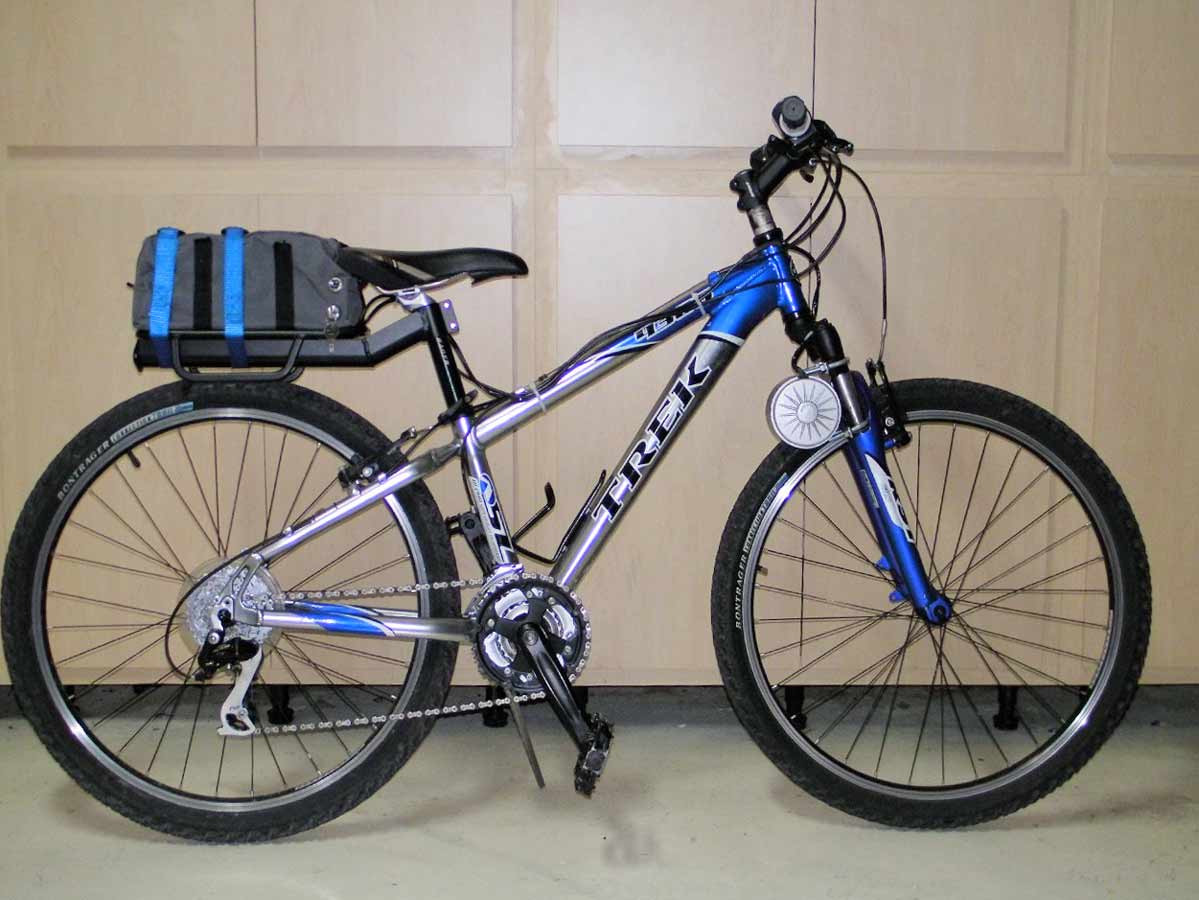
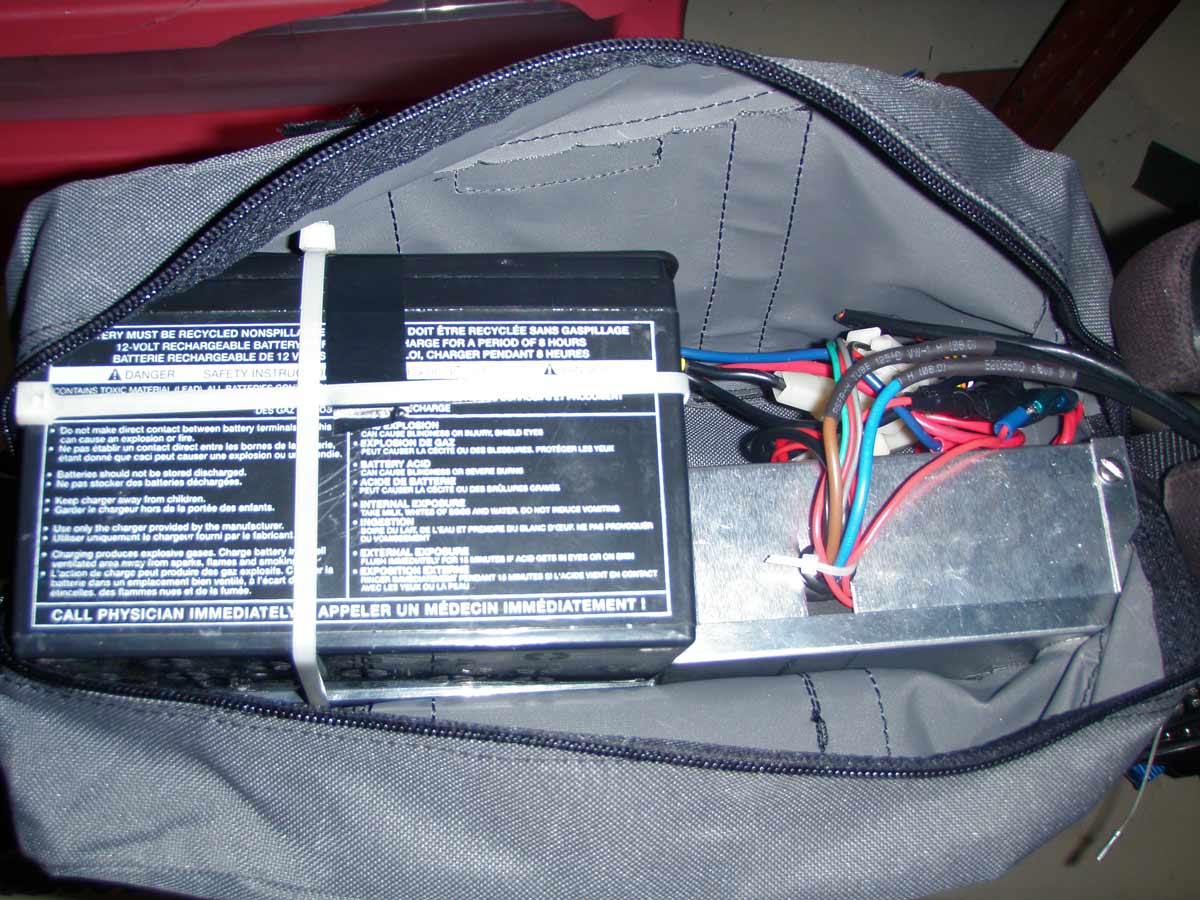
The SLA batteries and motor controller were stored in a canvas tool bag atop a pre-existing carrier rack. On larger bikes, like my later Trek 4-Series, this "tool bag" can be strapped to a modified (simply bent open) cup holder in the center of the frame. The scooter's throttle handle follows a standard diameter and easily clamps on between the shifter and right handle grip of the bike.
This was the setup I drove for a couple years before I out-grew my bike. No worries though, I found that this system is easily transferable to most other Trek Bycicles (and possibly other brands as well) after I got my Trek 4-Series. It only takes four nuts, a small tie-down strap, and one zip-tie for anyone to remove or transfer this system to another bike.
On a full charge, with two 12v 10Ah SLA batteries (a bit larger then the scooter's original 7Ah set), this motorized bike will pull you along at 20mph (32.2Kph) for 10 miles (16.1Km) seldom-assisted (I.e. only helping it when accelerating from stops). It certainly adds loads of fun to an otherwise normal bike ride.
To this day I have not found a better diy electric bicycle conversion with all the benefits of this one. It doesn't damage or alter the bike itself in any way, it's easily removed or transferred to other bikes, and it costs virtually nothing compared to the commercial kits and hub motors.
Build it yourself!
For starters, you will need a bicycle, preferably with lockable front suspension (if any) and enough room on the front fork tube for two 1.75" or 1.5" by 1/4" U-bolts and your (replacement) motor for a Razor E300 scooter (~$30). You will also need a 8mm (ideally), 5/16", 3/8", 1/2", or 5/8"(larger ones with spacers) motor arbor adapter, an old skateboard wheel, and a little bit of ingenuity to complete the drive system. A small strip of non-slip grit tape on the drive wheel will ensure traction in wet weather.
Almost everything with the exception of the arbor and U-bolts can be found on an old or damaged Razor E300 scooter.
Early progress photo
Video!
By request, here is a short video I compiled using old clips of the motor mounting process:
On my motor, the four mounting holes were measured to be about 92mm by 42mm apart. Also, I had to file a tiny bit off the outer curve of one U-bolt to get it to fit into a tight spot without any unnecessary stress on the front fork assembly.
Most Trek Mountain bikes should accept this bracket without modification. The two I tested were the Trek 4-Series and the Trek 4300.
I also strongly suggest you stuff a piece of rubber or non-slip alternative between the U-bolts and fork tube. This will prevent the motor from falling out of alignment and loosing grip with the front tire.
You will want to deflate the front tire briefly in order to get the motor alined and locked into place. You don't want too much pressure between the drive wheel and front tire, otherwise you will loose efficiency and cause excessive stress on the motor shaft and its bearings.
Your motor arbor adapter should already be installed on the motor and skateboard wheel. You will want this mounted firmly with as little rotational wobble as possible. Hack in some spacers if you are using a larger arbor. This will reduce any unnecessary vibration or fatigue on the motor.
Alternatively, you may need to consider getting creative with some two-part epoxy. In my first iteration of this e-bike, I simply epoxied a skateboard wheel to the motor shaft, nut, and sprocket directly. This worked for a little while, but soon the bond between the epoxy and polyurethane wheel broke and caused the two to spin freely of each other. I also couldn't get the drive wheel to run in the middle of the tire due to the motor shaft's length.
For a quieter ride, I suggest you use hybrid tires on your bike (if applicable). These have a smooth center strip which increases traction on both roads and the main drive wheel.
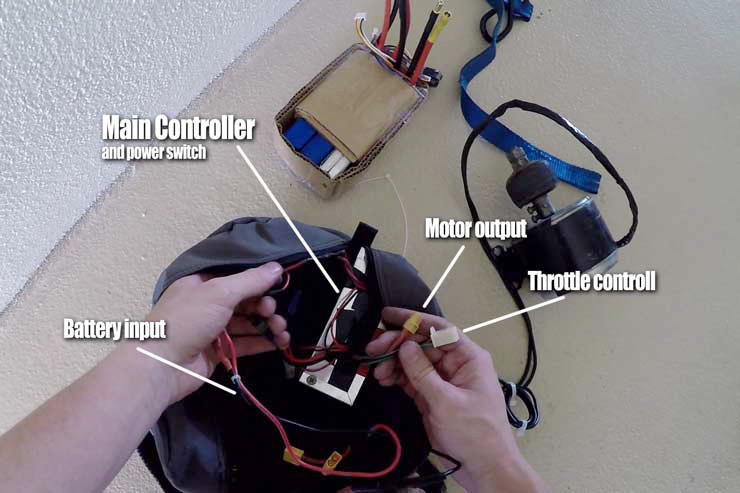
Once you have the motor installed, it's time to get the electronics in order. For this you will need your (replacement) "control module" and throttle handle from the Razor E300 scooter (~$30). You will also need to find two 12v 7 to 10Ah SLA batteries capable of supplying enough current for this system.
Other miscellaneous items include a main 12-20A power switch (or key switch), battery charger (scooter's original?), heavy-gauge wire, and appropriately-rated connectors (I used HobbyKing's XT60s with 12AWG wire.)
Finally, you will need a case or tool bag to put everything in and a way to mount it to your bike.
I used a generic tool bag strapped to a bent open cup holder to hold all my electronics for this project. On my previous smaller bike, it was mounted to the rear luggage rack (seen below).
An early picture from the archives.
Once you get everything securely nestled into the tool bag or box, you will need to mount it to your bike somehow.
On small bikes you may need to simply strap it to a rear seat-mount rack/carrier as seen below.
On larger bikes, a modified (bent open) cup holder mounted in the center of the frame will do just fine. This is what I use today.
The last step is to mount the throttle handle and route the remaining wiring along the bike's frame. Make sure to leave enough slack between the front fork and frame to facilitate unrestricted movement of the handlebars.
After a few hours of charging you should be good to go!
If the performance does not meet your expectations, try altering the size of the motor's drive (skateboard) wheel or investing in larger, more capable batteries.
If you run into a problem, it is up to you to use your creativity and ingenuity to solve it. If your bike does not fit this motor, or you don't have access to Razor scooter parts, use the ideas presented here to come up with your own design. Then share it with the world so others can make or build upon it.
Taking the DIY E-Bike Off-Road (and into the water)
There have been a few questions about this ~300w ebike and the places it can go. I try to address some of those through experimentation in this video.
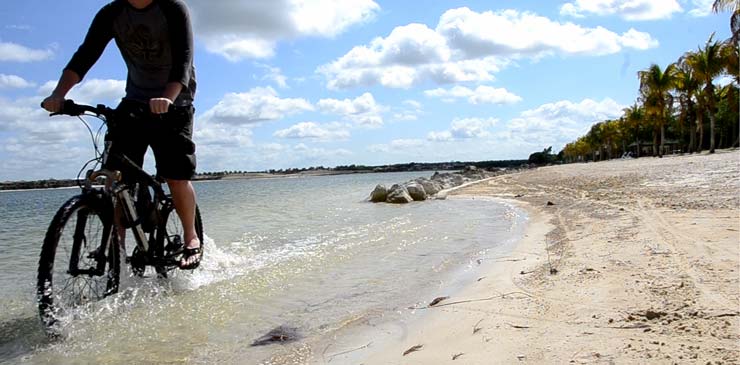
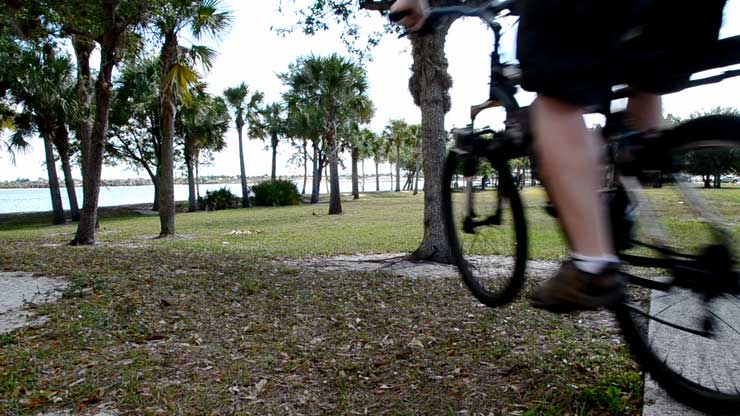
Among the tests done, I go over a few speed bumps, jump the curb, zip through some uneven grass, displace some sand, and hit the waves. All on two wheels.
The industrial outdoor grit/grip tape on the skateboard drive wheel helps keep traction in wet conditions, like rain. Without it, the two wheels might break traction and wear out the tire.
This bike has a locking lever on its front fork tube. Normally, it gives the rider a more efficient ride when riding on pavement or asphalt by preventing energy from being absorbed in the suspension with every crank of the peddles.
Since the motor clamps to the inner suspension tube with a couple U-bolts, the suspension must remain locked, as is the case with this bike. Otherwise a large series of jolts on the front wheel may disengage it from the motor's drive wheel.
Towards the end of the video (6:21 - end) there is also a brief overview of the electronics.
I also discovered that the controller will take 34 volts from an 8s LiPo pack. This makes the whole thing loads more fun with the added acceleration and extra 3 to 5mph boost.
It also seems like the controller actively regulates max current to the motor, preventing damage to it or the motor.